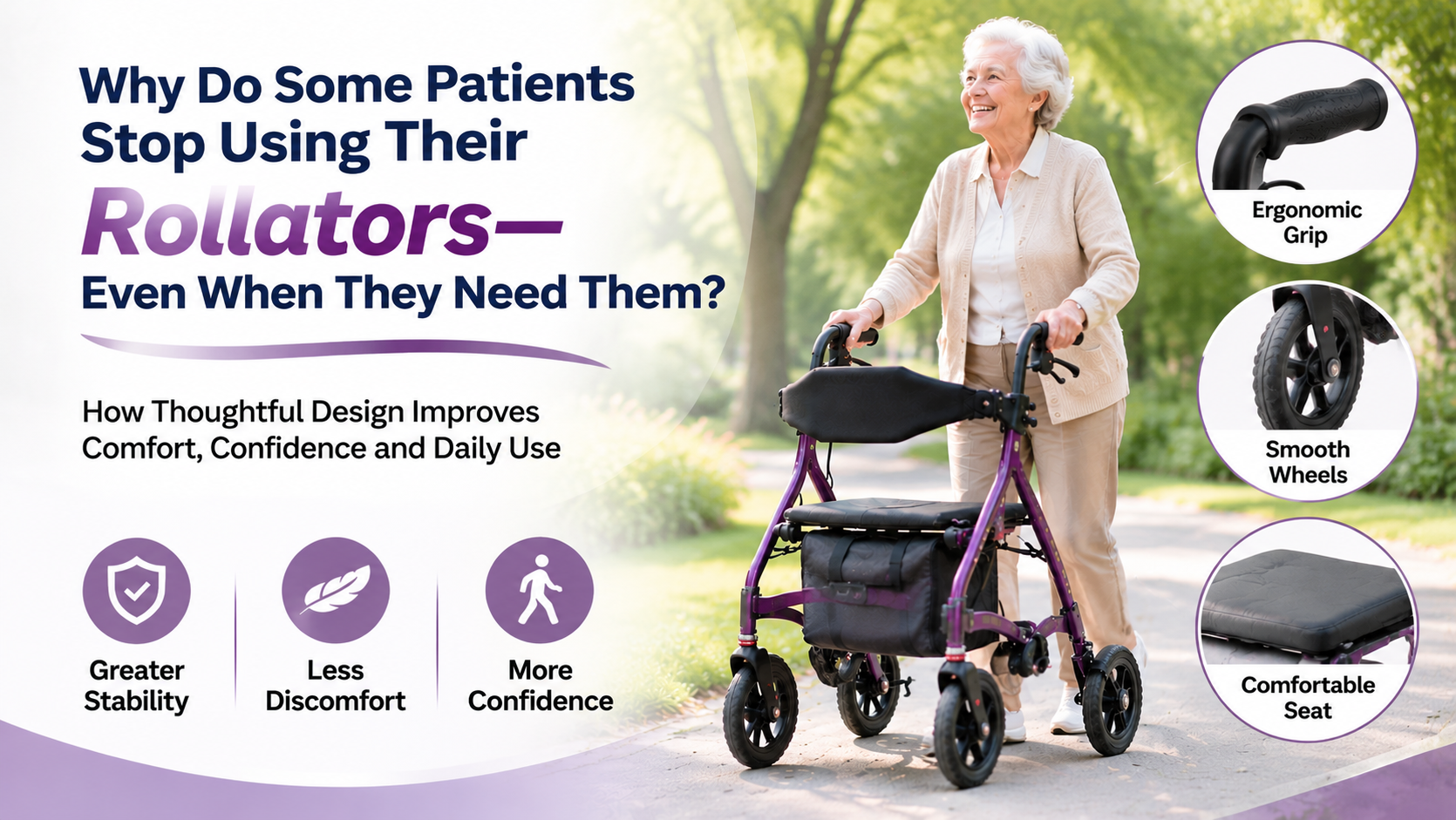
Why Do Some Patients Stop Using Their Rollators—Even When They Need Them?
In clinical practice, mobility aids are often prescribed with a clear goal:
to help patients stay active, safe, and independent.
Yet many healthcare professionals have observed a common issue:
Some patients gradually stop using their rollators—even when they still need them.
This is not always due to medical factors.
In many cases, the reason is simpler:
👉 The rollator is uncomfortable, difficult to use, or does not feel safe.
This highlights an important but often overlooked point:
Rollator design does not just affect mobility—it directly influences patient behavior, confidence, and daily activity levels.
The Link Between Mobility, Activity, and Health
Maintaining mobility is closely associated with overall health in elderly populations.
· According to the World Health Organization (WHO), reduced physical activity is linked to higher risks of functional decline, falls, and loss of independence
· Studies in geriatric care consistently show that regular movement supports muscle strength, balance, and cardiovascular health
However, mobility is not just about physical capability.
It also depends on whether patients:
· feel comfortable moving
· feel safe while walking
· are confident enough to stay active
This is where rollator design becomes highly relevant.
When Design Becomes a Barrier Instead of a Support
1. Discomfort Reduces Usage Time
If a rollator causes discomfort, patients tend to limit how long they use it.
Common issues include:
· hard or poorly shaped handles leading to hand fatigue
· insufficient seat support
· excessive vibration during walking
Over time, this can lead to reduced usage, which may contribute to lower activity levels.
A small observational study in rehabilitation settings found that patients were more likely to discontinue use of assistive devices that caused discomfort, even when those devices were clinically appropriate.
2. Instability Creates Fear of Falling
Stability plays a central role in patient confidence.
If a rollator feels:
· unstable during turning
· difficult to control on uneven surfaces
· unreliable when braking
patients may become cautious or hesitant.
This hesitation can lead to:
· shorter walking distances
· avoidance of outdoor movement
· increased dependence on caregivers
Given that falls are a leading concern in elderly care, even perceived instability can significantly affect behavior.
3. Poor Usability Increases Cognitive Load
For elderly patients, especially those with mild cognitive decline, ease of use matters.
Complex features such as:
· difficult folding mechanisms
· non-intuitive brake systems
· heavy frames
can discourage independent use.
If a device requires too much effort to operate, patients may choose not to use it at all.
4. Aesthetic and Social Factors Influence Willingness
Although less discussed in clinical settings, appearance can also influence usage.
Some patients report reluctance to use devices that appear:
· overly medical
· bulky
· outdated
This can affect their willingness to:
· go outdoors
· participate in social activities
· use the device in public
How Design Improves Comfort and Daily Use
1. Ergonomic Design Supports Natural Movement
Well-designed rollators consider:
· handle angle and grip shape
· proper height adjustment
· alignment with natural walking posture
These factors help reduce strain on:
· wrists
· shoulders
· lower back
Patients who experience less discomfort are more likely to use the device consistently.
2. Smooth Mobility Reduces Physical Effort
Features such as:
· larger wheels
· improved rolling resistance
· shock-absorbing elements
can make walking smoother and less tiring.
This is particularly important for patients with:
· joint pain
· reduced muscle strength
· post-surgery fatigue
3. Resting Features Encourage Longer Activity
Rollators with:
· stable seating
· back support
allow patients to take breaks during movement.
This can extend the duration of outdoor or daily activities, especially for those with limited endurance.
How Design Influences Confidence
Comfort alone is not enough—confidence is equally important.
1. Stability Builds a Sense of Safety
A rollator with:
· a stable frame
· consistent wheel contact
· reliable braking
helps patients feel secure.
This perceived safety often determines whether a patient is willing to walk independently.
2. Control Improves User Confidence
When patients feel that they can:
· steer easily
· stop reliably
· manage the device without assistance
they are more likely to:
· explore their environment
· increase movement
3. Reliability Encourages Trust
Consistency matters.
If a rollator performs predictably over time, patients develop trust in the device.
This trust supports:
· regular use
· reduced anxiety
· greater independence
From Design to Behavior: A Practical Perspective
The relationship between design and patient outcomes can be understood as a chain:
Well-designed rollator → greater comfort and confidence → increased usage → higher activity levels
Conversely:
Poor design → discomfort or fear → reduced usage → lower activity levels
While mobility aids alone do not determine health outcomes, they play an important supporting role in daily activity.
Real-World Perspectives
A physiotherapist in Germany shared:
"When patients feel stable and comfortable, they tend to walk more during the day. That consistency is important for maintaining function."
A patient in a community care program noted:
"With my previous walker, I felt unsteady and tired quickly. After switching to a better one, I started going outside again."
These examples highlight how design influences not only physical use, but also behavior and mindset.
Implications for Healthcare Procurement
For healthcare providers and procurement teams, this raises an important consideration:
Selecting a rollator is not only about technical specifications—it is about real-world usability.
1. Consider Patient Experience, Not Just Features
Key evaluation factors should include:
· comfort during prolonged use
· ease of operation
· perceived stability
2. Match Design to Patient Needs
Different patients may require different priorities:
· higher stability for fall-risk patients
· lighter weight for active users
· enhanced comfort for long-term use
3. Look Beyond Initial Cost
A device that improves usage and reduces issues such as falls or non-compliance may provide better long-term value.